Nutrixe
They do not carry the word “wheat” in their name. They appear in dishes that look healthy, plant-based, Mediterranean. And they are wheat from the first molecule to the last. Here are the false friends every person with celiac disease learns, usually after being caught once.
Seitan: gluten in its pure state
Seitan is the extreme case. It is made by kneading a wheat flour dough, then washing it with water until the starch is removed. What remains, an elastic grey mass, is gluten, almost pure, cooked in broth. The result is prized in vegetarian cooking for its meat-like texture.
A person with celiac disease cannot go near it. Seitan is to gluten what sugar is to sweetness: it does not contain it, it is it. It hides in “veggie steaks”, “vegetable sausages”, vegan restaurant dishes, vegetarian kebabs, and under its other names: wheat gluten, wheat protein, wheat meat, mianjin in Chinese cooking. In a vegetarian restaurant, “what is it made of?” is indispensable before any “meat-style” dish.
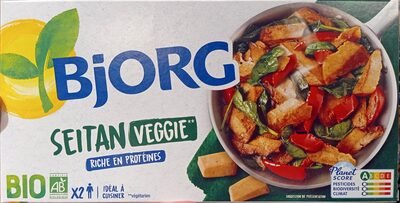
Photo and ingredient list: Open Food Facts, a collaborative open-licence database, retrieved on 5 September 2026. Recipes change: the label on the product in your hand is what counts.
Wheats under another name
Kamut is a registered trademark for Khorasan wheat, an ancient large-grained durum variety, grown today mostly in North America. Sold as flour, flakes, pasta, bread, with the “ancient” and “digestible” arguments we take apart for spelt. Same conclusion: wheat, with gluten.
Couscous is durum wheat semolina moistened and rolled into grains, then dried. Neither a separate cereal nor a neutral starch: wheat. “Wholegrain” couscous too. The only exceptions are corn, millet, quinoa or buckwheat couscous, sold with the “gluten-free” claim, not to be confused in a restaurant, where couscous is always wheat.
Bulgur is parboiled, dried, cracked durum wheat. It makes traditional Lebanese tabbouleh, Turkish kisir, many “healthy” deli salads. Wheat.
Freekeh is durum wheat harvested green, roasted and cracked, very present in Levantine and Maghreb cooking, in soups, as a side. Wheat.
Farro is the Italian name for three ancient wheats (einkorn, emmer, spelt). In salad, in soup, in “farrotto” risotto: wheat.
Triticale is a wheat-rye cross, grown for fodder and sometimes for “alternative” baking. Two gluten cereals for the price of one.
Pearl barley and hulled barley, often in soups and grain salads, are not wheats but contain gluten. Malt comes from it; an article is devoted to it.
The true friends, so as not to mix everything up
They look like the above on the plate and have nothing to do with them:
- Quinoa, millet, amaranth, buckwheat, teff, sorghum, fonio: gluten-free by nature.
- Rice, in all its forms, including wild rice (not a rice but an aquatic grass, gluten-free).
- Pulses: lentils, chickpeas, beans, hence hummus, falafel (careful: some falafel is bound with wheat flour), lentil pasta.
- Corn, potato, cassava.
Their only risk is supply-chain contamination, mill, transport, bulk bins, which is settled by buying labelled “gluten-free”.
The question to ask
In a Mediterranean, Middle Eastern or vegetarian restaurant, the question is not “is it gluten-free?”: the answer will often be “yes, it’s couscous” or “yes, it’s plant-based”. The question is: “What grain is it made with?” If the answer contains wheat, spelt, kamut, bulgur, couscous, freekeh, farro, seitan, barley or rye, it is no. If it contains rice, quinoa, millet, buckwheat, corn or pulses, you can proceed, then checking the kitchen, since a mixed kitchen is still a mixed kitchen.
In short
| Contains gluten | Gluten-free by nature |
|---|---|
| seitan, wheat gluten, wheat protein | quinoa, millet, amaranth |
| kamut (Khorasan wheat), spelt, farro, triticale | buckwheat, teff, sorghum, fonio |
| couscous, bulgur, freekeh | rice, wild rice |
| barley (pearl, hulled), rye, malt | corn, potato, cassava, pulses |
Scan the packet. The Nutrixe scanner recognises seitan, kamut, bulgur, couscous, farro, einkorn and triticale for what they are: wheat, even when the word is not there. Discover the app.