Nutrixe
On French supermarket shelves, gluten-free flour comes in two forms: single flours (rice, corn, buckwheat…) and “bread”, “baking” or “all-purpose” mixes. The former replace wheat flour in a sauce, a crêpe or a cake that rises with eggs; the latter are designed to rise and hold together like a wheat dough. Leclerc and Auchan sell mixes under their own brand, and Auchan single flours too; at Carrefour, Intermarché and Lidl, we mostly found other brands. Of 9 flours checked, our scanner shows 5 as “Certified gluten-free”, 3 as “Labelled gluten-free” and 1 as “May contain traces of gluten”.
How this survey was done. On 16 November 2026, we searched Open Food Facts for flours sold in France with a “gluten free” claim: the database lists 365, including 10 linked to Auchan, 9 to Carrefour, 2 to Leclerc, 2 to Intermarché and 1 to Lidl. We read in detail the flours of supermarket own brands and of brands seen in those shops, kept those updated since 2025, and ran each one through our scanner's engine. The shops are the ones contributors recorded: the list is partial and may be out of date, and the range varies from one shop and one click-and-collect service to another.
Single flour or mix: which to choose
In a wheat dough, gluten forms an elastic network that holds the gas from the yeast and gives the crumb. A gluten-free flour has none: on its own, a rice or buckwheat flour gives a dense loaf that does not rise. Hence two uses.
- Single flours (rice, corn, buckwheat, chickpea, chestnut, almond…): to thicken a sauce, make crêpes, galettes, biscuits, or a cake that rises with eggs. They are also the building blocks of a home-made mix.
- “Bread” mixes: starches (corn, potato, tapioca), a little flour, and a binder that mimics gluten: psyllium, guar gum, xanthan gum, carob seed flour. Some include a sachet of yeast. We explain the role of these binders in our article on xanthan gum, guar gum and psyllium.
- “Baking” or “all-purpose” mixes: finer, often rice flour, potato starch and corn starch, with a little psyllium or gum. They replace wheat flour in a cake, a pastry, a béchamel.
The real difference for people with coeliac disease lies elsewhere: it is the “gluten free” claim. A grain of rice or buckwheat has no gluten, but the flour carries the dust of the mill, and a mill that grinds wheat leaves some in the next flour. Regulation (EU) No 828/2014 reserves “gluten free” for products under 20 mg/kg; the Crossed Grain symbol, licensed in France by AFDIAG, the French coeliac association, adds testing of every product and an audit of the mill. For flour, this is where the logo matters most.
Supermarket by supermarket
| Supermarket | Flour checked | What matters on the label | Scanner verdict |
|---|---|---|---|
| Leclerc (Chaque Jour Sans Gluten) | All-purpose mix (1 kg) | Rice flour 46.9%, potato starch 27.3%, corn starch 24.4%, psyllium. Trace of egg | Labelled gluten-free |
| Leclerc (Chaque Jour Sans Gluten) | Bread and baking mix (1.016 kg) | Corn starch, dextrose, buckwheat flour, guar gum, carob; sachet of yeast | Labelled gluten-free |
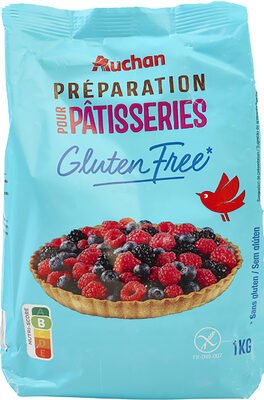
| Auchan (Gluten Free) | Baking mix (1 kg) | Rice flour, potato starch, corn starch, psyllium, guar gum. Traces of egg. Crossed Grain symbol recorded | Certified gluten-free |
| Auchan (Gluten Free) | Rice flour (500 g) | Rice flour. Traces of egg. Crossed Grain symbol recorded | Certified gluten-free |
| Auchan (Gluten Free) | Corn flour (500 g) | Corn flour. Traces of egg. Crossed Grain symbol recorded | Certified gluten-free |
| Auchan (Gourmet) | Buckwheat flour (1 kg) | Buckwheat flour. “Traces of gluten” | May contain traces of gluten |
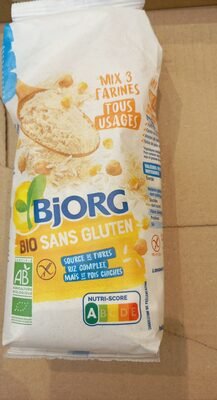
| Intermarché (Bjorg) | Organic all-purpose 3-flour mix (500 g) | Wholegrain rice 60%, corn 15%, corn starch 15%, chickpea 10%. Crossed Grain symbol recorded | Certified gluten-free |
| Intermarché, U, carrefour.fr (Mon Fournil) | Organic wholegrain rice flour (400 g) | Wholegrain rice flour. Traces of soya. Crossed Grain symbol recorded | Certified gluten-free |
| Lidl (Belbake) | Corn starch | 100% corn starch | Labelled gluten-free |
Leclerc
Leclerc’s Chaque Jour Sans Gluten range has no single flour, but a one-kilo all-purpose mix, “for savoury and sweet recipes”, listed at €4.65 on the e.leclerc website on 16 November 2026. Open Food Facts also records a 1.016 kg bread and baking mix, in two 500 g bags with their yeast, which the e.leclerc website did not show that day.
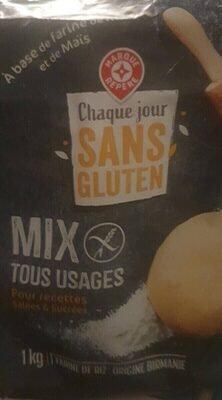
The rest of the range, from pasta to pizza dough, is in our article on gluten free at Leclerc.
Carrefour
Under its own brand, Carrefour has sold in France a one-kilo “No Gluten” mix for special bread and baking (corn starch 85%, sugar, xanthan gum, emulsifier, baking powder). Its Open Food Facts entry has not been updated since 2023: we do not count it and do not know whether it is still on the shelves. The Carrefour-brand gluten-free rice, corn and chickpea flours recorded on Open Food Facts are Spanish. At Carrefour in France, contributors mostly recorded other brands: Mon Fournil rice flour, Mon Fournil corn flour, Schär’s Mix C.
Intermarché
We found no gluten-free flour under an Intermarché brand. Contributors recorded two certified flours there: Bjorg’s 3-flour mix and Mon Fournil’s wholegrain rice flour.
Auchan
This is the supermarket where we found the most own-brand flours, under the “Gluten Free” label: a baking mix, a rice flour and a corn flour, all three with the Crossed Grain symbol recorded.
But in the same aisle, another Auchan flour shows why the claim matters: the buckwheat flour from the Gourmet range, stone-ground, has no “gluten free” claim on the front, and its ingredient list announces traces of gluten.
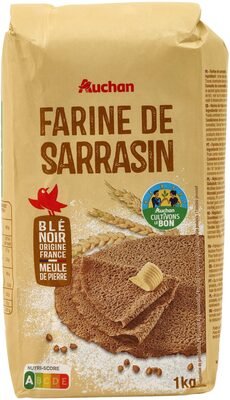
This is the case described in our article on buckwheat: a plant with no gluten, milled in a supply chain that has some.
Lidl
In France, Open Food Facts links only one product in this aisle with a “gluten free” claim to Lidl: a Belbake corn starch, which is used to thicken a sauce and is not a flour (we explain the difference in our article on cornflour and Maïzena). The same Belbake brand has gluten-free flours recorded in Spain, which we did not see in France. Lidl wrote in October 2026 that gluten-free products are not part of its permanent range in France; what exists is sold in occasional promotions, from one week to the next. We go into what the chain does elsewhere in our article on Aldi and Lidl.
Schär
Schär, the specialist brand most present in supermarkets, sells its flours as mixes: Mix B for bread, Mix C for baking. Mix C has been seen at Auchan, at U and on carrefour.fr; according to its entry, it combines corn starch, corn flour, rice flour, lentil flour, modified tapioca starch and carob seed flour. We do not give its verdict: its ingredient list on Open Food Facts is a damaged automatic reading of the label, and our scanner cannot draw a reliable answer from it. The box is what counts.
Photos and ingredient lists: Open Food Facts, a collaborative open-licence database, retrieved on 16 November 2026. Recipes change: the label on the packet in your hand is what counts.
Single flours, one by one
Each flour has its own pitfalls, which we cover separately: rice, corn and cornflour, buckwheat, chickpea flour, chestnut flour, almond flour, quinoa, and millet, teff and sorghum. One rule applies to them all: never from bulk bins, where scoops move from one bin to the next.
The table
| Gluten free | To check | Contains gluten |
|---|---|---|
| Flours and mixes with the Crossed Grain symbol; flours with a “gluten free” claim | Rice, corn, buckwheat or chickpea flours with no claim at all; flours with “traces of gluten”; flours from bulk bins | Wheat, spelt, einkorn, rye and barley flour; regular oat flour |
In short
- A single flour (rice, buckwheat…) will not make bread rise; a “bread” mix adds starches and a binder.
- Leclerc sells an all-purpose mix, Auchan a baking mix and certified rice and corn flours; at Carrefour, Intermarché and Lidl, we mostly found other brands, or nothing in France.
- Of 9 flours, 5 come out “certified” on the scanner, 3 “labelled”, 1 with traces.
- For flour, the “gluten free” claim matters more than for any other product: the mill is the risk.
A flour with no logo in your basket? The scanner in the Nutrixe app reads its entry and flags traces of gluten, the manufacturer's claim or the Crossed Grain symbol. Free, no account needed.
See also
- Leclerc gluten free in France: pasta, pizza, bread, flour
- Gluten-free pasta in France: Barilla, Leclerc, Carrefour, Lidl
- Which gluten-free bread to choose, from a bakery or a supermarket?
- Eating gluten free on a budget
- “May contain traces of gluten”: what to make of it
Sources
- Commission Implementing Regulation (EU) No 828/2014: the “gluten free” claim reserved for foods containing no more than 20 mg/kg of gluten.
- Regulation (EU) No 1169/2011, Annex II: cereals containing gluten (wheat, including spelt, rye, barley, oats) to be declared as allergens.
- AFDIAG, Logo « épi barré » (in French), accessed 16 November 2026: testing of every product (under 20 mg/kg) and audit of the manufacturing site, renewed every year; a naturally gluten-free product can be contaminated during transport or packaging.
- E.Leclerc, Farine multi usages sans gluten 1 kg (in French), accessed 16 November 2026: ingredients and listed price.
- Lidl France, LIDL vend-il des produits bio / sans gluten ?, service-client.lidl.fr (in French), checked in October 2026: gluten-free products are not part of the permanent range, only occasional promotions.
- Open Food Facts, entries 3564706695825 (Leclerc, all-purpose mix), 3564700653616 (Leclerc, bread and baking mix), 3596710382866 (Auchan, baking mix), 3596710453917 (Auchan, rice flour), 3596710443017 (Auchan, corn flour), 3596710474431 (Auchan Gourmet, buckwheat flour), 3229820794891 (Bjorg, 3-flour mix), 3760130560726 (Mon Fournil, rice flour), 20012182 (Lidl Belbake, corn starch), 8008698004852 (Schär, Mix C) and 3560070546749 (Carrefour, special bread mix, 2023 entry), accessed 16 November 2026.
This information is no substitute for medical advice. If you have coeliac disease, your doctor, your dietitian or a patient association such as Coeliac UK can help you plan your shopping.