Nutrixe
Most gluten-free pasta in French supermarkets is made from corn flour and rice flour; some is made from a single pulse (lentils, peas) or from buckwheat. Every French supermarket chain we looked at sells it under its own brand, alongside Barilla, Panzani or Schär. Of 20 packets checked, our scanner shows 7 as “Certified gluten-free” and 13 as “Labelled gluten-free”; and several of the latter actually carry the Crossed Grain symbol on the box. Here is what they are made of, brand by brand, and where Open Food Facts has seen them.
How this survey was done. On 16 November 2026, we searched Open Food Facts for pasta sold in France with a “gluten free” claim: the database lists 670, including 21 linked to Carrefour, 27 to Auchan, 12 to Leclerc, 9 to Lidl and 3 to Intermarché. We read 20 packets in detail, among the most scanned and the supermarket own brands, updated since 2025, and ran each one through our scanner's engine. The shops are the ones contributors recorded: the list is partial and may be out of date, and a packet seen at Auchan may well be found at Leclerc. Availability also varies from one shop and one click-and-collect service to another.
What gluten-free pasta is made of
In durum wheat pasta, gluten is what keeps the pasta firm when cooked. Without it, manufacturers rely on three families of flour.
- Corn and rice. This is the recipe of almost all supermarket own brands and of Barilla: about two thirds corn (white and yellow), a third or less rice, sometimes brown rice, and often an emulsifier, mono- and diglycerides of fatty acids (E471), to hold the pasta together. Corn and rice have no gluten; we go into detail in our articles on corn and rice.
- Pulses. A single flour, from red lentils, split peas or chickpeas, sometimes with a vegetable. More protein and fibre, a stronger taste. Lentils have no gluten, but a pulse flour carries traces from the mill: the “gluten free” claim matters.
- Buckwheat. Despite its French name of “blé noir” (black wheat), buckwheat is not wheat. But watch out for soba noodles and some “buckwheat” pasta, which mix it with wheat flour: the ingredient list says so.
Einkorn, kamut or “ancient grain” pasta is not gluten-free pasta: these are all wheats. We explain this in our article on spelt.
Brand by brand
| Brand | Packet checked | Composition | Shops recorded on Open Food Facts | Scanner verdict |
|---|---|---|---|---|
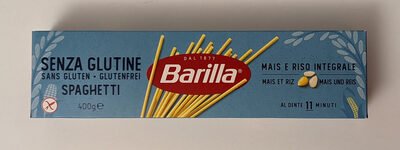
| Barilla | Gluten-free spaghetti (400 g) | White corn 60%, yellow corn 29.5%, brown rice 10%, emulsifier. Crossed Grain symbol on the box | None in France on the entry, which is shared by six countries | Labelled gluten-free |
| Barilla | Red lentil pasta (250 g) | Red lentil flour. Crossed Grain symbol recorded | Auchan | Certified gluten-free |
| Leclerc, Marque Repère “Chaque Jour Sans Gluten” | Spaghetti, coquillettes, fusilli, penne (400 g) | White and yellow corn, rice, emulsifier. Crossed Grain symbol on the bag | Leclerc | Labelled gluten-free (4) |
| Leclerc, Marque Repère “Chaque Jour Sans Gluten” | Spaghetti, penne, coquillettes (500 g) | Corn 79.6%, rice 19.9%, emulsifier. Crossed Grain symbol recorded | Leclerc | Certified gluten-free (3) |
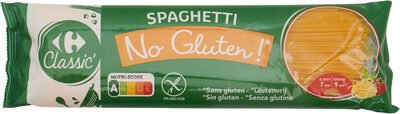
| Carrefour “No Gluten” | Spaghetti (500 g) | Corn 70%, rice 30%. Crossed Grain symbol recorded | Carrefour | Certified gluten-free |
| Carrefour | Split pea fusilli (250 g) | 100% split pea flour | Carrefour | Labelled gluten-free |
| Auchan “Gluten Free” | Gluten-free spaghetti (500 g) | White corn 65%, yellow corn 29.25%, rice 5%, emulsifier. Crossed Grain symbol recorded | Auchan | Certified gluten-free |
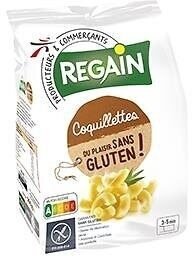
| Intermarché, Regain | Gluten-free coquillettes (500 g) | Corn 70%, rice 30%. Crossed Grain symbol on the bag | Intermarché | Labelled gluten-free |
| Lidl, Combino | “Gluten Free” spaghetti (500 g) | Corn 98%, chickpea, emulsifier. Traces of egg | Lidl | Labelled gluten-free |
| Lidl, Combino | Red lentil rollini (250 g) | 100% organic red lentil flour | Lidl | Labelled gluten-free |
| Panzani | Gluten-free spaghetti (400 g) | Brown rice 37.5%, yellow corn 35%, white corn 15%, white rice 12%, emulsifier | Carrefour Market | Labelled gluten-free |
| Schär | Penne No. 21 (500 g) | Corn, rice, millet 20%, emulsifier. Traces of soya | Lidl | Labelled gluten-free |
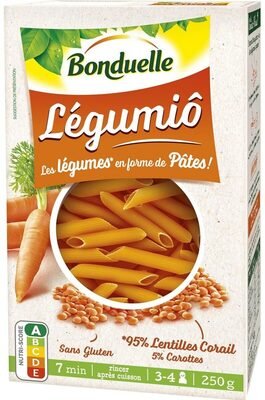
| Bonduelle, Légumiô | Red lentil and carrot pasta (250 g) | Red lentils 95%, carrots 5%. Traces of soya | Auchan, Carrefour, Intermarché, Leclerc, U | Labelled gluten-free |
| Felicia | Organic buckwheat tortiglioni (340 g) | 100% buckwheat flour. Crossed Grain symbol recorded | Carrefour | Certified gluten-free |
| Les Moulins de Provence, Biovence | Buckwheat twists (250 g) | Organic buckwheat flour | Auchan, carrefour.fr | Labelled gluten-free |
What the table does not say: a “Labelled” product is not by nature less safe than a “Certified” one. The “gluten free” claim commits the manufacturer to less than 20 mg/kg of gluten, under Regulation (EU) No 828/2014; the Crossed Grain symbol, licensed in France by AFDIAG, the French coeliac association, adds testing of every product and an audit of the factory, every year. And on several “Labelled” packets the logo is indeed printed: it is the Open Food Facts entry that does not have it yet. Our article on the Crossed Grain symbol explains how to recognise it.
Barilla: the ingredients
This is the most common search about the brand. Barilla’s gluten-free spaghetti is made from white corn flour (60%), yellow corn flour (29.5%), brown rice flour (10%), water and an emulsifier (mono- and diglycerides of fatty acids). The box, in Italian, French and German, says “Senza glutine · Sans gluten · Glutenfrei” and carries the Crossed Grain symbol on the front.
Barilla also sells pulse pasta (red lentils, chickpeas); the 250 g red lentil pasta checked here has the logo recorded and comes out “Certified gluten-free”.
Leclerc and Marque Repère
Leclerc’s gluten-free pasta belongs to the Chaque Jour Sans Gluten range, under Marque Repère, the chain’s own brand: spaghetti, coquillettes (short macaroni), fusilli and penne in 400 g bags, egg tagliatelle, and a corn couscous. On 16 November 2026, the e.leclerc website listed the 400 g bags at between €1.59 and €1.71, or around €4 per kilo. The rest of the range, from bread to pizza dough, is in our article on gluten free at Leclerc.
Carrefour, Auchan, Intermarché
Carrefour sells 500 g “No Gluten” spaghetti, fusilli and penne, made from corn and rice flour, with the Crossed Grain symbol, as well as 100% pulse pasta under its own brand.
Auchan sells its gluten-free pasta under the “Gluten Free” label of its Mieux Vivre range: the spaghetti checked has the Crossed Grain symbol recorded, and Open Food Facts also lists fusilli, penne, coquillettes and macaroni from the same range.
Intermarché sells it under its Regain brand. The coquillettes are a telling case: the entry records the Crossed Grain licence number (FR-059-007), but not the logo itself, so the scanner shows “Labelled gluten-free” even though the bag carries the logo.
Lidl
Lidl sells, under its Combino brand, gluten-free spaghetti (98% corn flour) and red lentil rollini; Open Food Facts has also seen Schär penne at Lidl. In France, Lidl wrote in October 2026 that gluten-free products are not part of its permanent range: these packets come and go from week to week. What Lidl does in other countries is in our article on Aldi and Lidl.
Pulse pasta
There is more and more of it, from Bonduelle, Barilla, Lidl or Carrefour. Just one precaution: the “gluten free” claim on the packet. Bonduelle’s Légumiô pasta carries it, without a logo.
Photos and ingredient lists: Open Food Facts, a collaborative open-licence database, retrieved on 16 November 2026. Recipes change: the label on the packet in your hand is what counts.
The table
| Gluten free | To check | Contains gluten |
|---|---|---|
| Pasta with the Crossed Grain symbol, or with a “gluten free” claim (corn-rice, pulses, buckwheat) | Pulse or buckwheat pasta with no claim at all; “buckwheat” pasta or soba (often cut with wheat); pasta cooked in the water or drained in the colander used for wheat pasta | Durum wheat, spelt, einkorn and kamut pasta; ordinary fresh and filled pasta |
Cooking it without contaminating it
At home, the gluten from wheat pasta stays in the cooking water and in the mesh of the colander. Cook gluten-free pasta in clean water, and keep a colander just for it: we go into detail in our article on cross-contamination in the home kitchen.
In short
- Gluten-free pasta is made from corn and rice, or from a pulse, or from buckwheat.
- Leclerc (Chaque Jour Sans Gluten), Carrefour (No Gluten), Auchan (Gluten Free), Intermarché (Regain) and Lidl (Combino) have their own-brand pasta, alongside Barilla, Panzani and Schär.
- Of 20 packets, 7 come out “certified” on the scanner and 13 “labelled”; several “labelled” ones have the Crossed Grain symbol on the box.
- Barilla: white corn 60%, yellow corn 29.5%, brown rice 10%.
- Pick pulse or buckwheat pasta with a “gluten free” claim.
Two packets of penne side by side? The scanner in the Nutrixe app reads their entries and tells you where the answer comes from: a certified logo, the manufacturer's claim, or the ingredient list alone. Free, no account needed.
See also
- Leclerc gluten free in France: pasta, pizza, bread, flour
- Gluten-free flour in France: Leclerc, Carrefour, Lidl, Intermarché
- Is corn gluten free?
- Lentils and pulses: gluten or not?
- Eating gluten free on a budget
Sources
- Commission Implementing Regulation (EU) No 828/2014: the “gluten free” claim reserved for foods containing no more than 20 mg/kg of gluten.
- Regulation (EU) No 1169/2011, Annex II: cereals containing gluten (wheat, including spelt and kamut, rye, barley, oats) to be declared as allergens.
- AFDIAG, Logo « épi barré » (in French), accessed 16 November 2026: testing of every product (under 20 mg/kg) and audit of the manufacturing site, renewed every year.
- E.Leclerc, Nos produits Chaque Jour sans Gluten and product page Coquillettes sans gluten 400 g (in French), accessed 16 November 2026: range and listed prices.
- Lidl France, LIDL vend-il des produits bio / sans gluten ?, service-client.lidl.fr (in French), checked in October 2026: gluten-free products are not part of the permanent range, only occasional promotions.
- Open Food Facts, entries 8076809545440 (Barilla, spaghetti), 8076809575140 (Barilla, red lentils), 3564706514195 and 3564700651292 (Leclerc, coquillettes and spaghetti), 3560070425204 (Carrefour, spaghetti), 3560071081362 (Carrefour, split pea fusilli), 3596710458233 (Auchan, spaghetti), 3250391986606 (Regain, coquillettes), 20284251 and 4056489290681 (Lidl Combino), 3038359004506 (Panzani), 8008698005880 (Schär), 3083681080971 (Bonduelle Légumiô), 8032804433069 (Felicia) and 3267460050458 (Les Moulins de Provence), accessed 16 November 2026.
This information is no substitute for medical advice. If you have coeliac disease, your doctor, your dietitian or a patient association such as Coeliac UK can help you plan your shopping.