 Nutrixe
Yes, cornstarch is gluten free: it contains no gluten. It’s pure starch extracted from maize, and Maïzena “Fleur de maïs” even carries the Crossed Grain symbol. The risk lies elsewhere: cornstarches with no gluten-free label that warn of gluten traces, products in the Maïzena range that aren’t cornstarch at all, and “cornflours” abroad that are made from wheat.
Cornstarch, cornflour, Maïzena: what are we talking about?
The same white powder goes by several names:
- Cornstarch, in American English;
- Cornflour, in British English;
- Maize starch or corn starch, the terms most often found on ingredients lists;
- Maïzena, the Unilever brand that has become a common noun in France.
It’s the starchy part of the grain, separated by wet milling: a white, tasteless powder that thickens as it cooks. Maize doesn’t contain the gluten that causes problems for coeliacs, the gluten in wheat, barley and rye; its main protein, zein, doesn’t trigger the coeliac reaction. Our article on corn goes into this in detail.
Not to be confused with corn flour in the American sense, which is the whole grain milled (yellow, used in batters), nor with the cornmeal used for polenta. All of them start out gluten free, but they don’t go through the same factories.
What’s still at risk
Factory traces
Cornstarch has no gluten; the factory that packs it may well have some. Some supermarket own-brand cornstarches carry a precautionary warning, and that warning is voluntary: a packet without one isn’t proof that the line is controlled. AFDIAG, the French coeliac association, is clear about these warnings: when in doubt, it advises avoiding these products.
Products from the brand that aren’t cornstarch
The Maïzena name appears on a whole range in France: thickeners, roux, sauce mixes. Some are made from potato starch and rice flour, others from wheat flour. A “Maïzena = gluten free” reflex can therefore go wrong.
The “cornflour” trap
In British English, cornflour means cornstarch, and Coeliac UK points out that cornflour made from maize is suitable for a gluten-free diet. But in Australia and New Zealand, shops also sell wheaten cornflour, a starch made from wheat: the Australian supplier Culpepers describes its own as “made from ground wheat”. In the United States, on the other hand, corn flour means milled maize, and the starch is called cornstarch. When travelling, read the ingredient, not the name.
In restaurants
Cornstarch is a good gluten-free thickener, but nothing says a sauce was thickened with it: many kitchens still thicken with a wheat-flour roux or use catering stock and gravy bases. Our article on stock cubes, sauces and condiments lists these traps.
Three packets, three answers
These three products are sold in France.
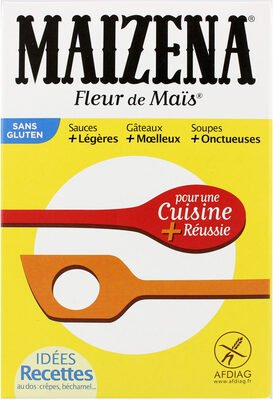

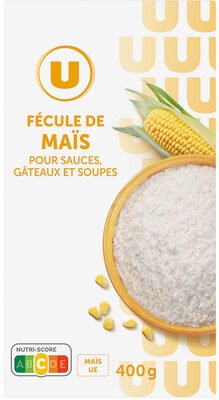
For the U cornstarch, the Open Food Facts entry lists gluten among the allergens, not just among the traces: the scanner, which always takes the most cautious reading, therefore shows it as “Contains gluten”, while the label talks about possible traces. Either way, the conclusion for a coeliac is the same: that packet stays on the shelf.
Photos and ingredient lists: Open Food Facts, a collaborative open-licence database, retrieved on 8 October 2026. Recipes change: the label on the packet in your hand is what counts.
The table
| No particular risk | To check | Contains gluten |
|---|---|---|
| Cornstarch or cornflour labelled “gluten free” or with the Crossed Grain | Cornstarch with no label at all | Roux and sauce mixes made with wheat flour |
| Maïzena “Fleur de maïs” | Cornstarch with a gluten traces warning (avoid) | “Wheaten cornflour” (Australia, New Zealand) |
| Thickeners and mixes from the range: read each box | Flour-thickened sauces in restaurants | |
| Cornstarch bought loose |
How to choose
- Look for the “gluten free” label. Commission Implementing Regulation (EU) No 828/2014 reserves it for products containing no more than 20 mg of gluten per kilo, contamination included.
- The Crossed Grain symbol adds an audit by a patient association; classic Maïzena has it. See what each logo is worth.
- Read the traces line. A “may contain gluten” or “may contain traces of cereals containing gluten” warning is enough to rule the packet out. Our article on “may contain” warnings explains why.
- Read the product, not the brand. The same brand sells pure cornstarch and wheat roux.
In short
- Cornstarch (cornflour in the UK) contains no gluten; Maïzena “Fleur de maïs” carries the Crossed Grain.
- The risk comes from factory traces on some unlabelled cornstarches, and from products in the range made with wheat flour.
- Abroad, “cornflour” can be wheat (Australia, New Zealand): read the ingredient.
- To thicken a gluten-free sauce, a cornstarch labelled “gluten free” is the simplest tool.
Not sure about a box? The Nutrixe scanner reads the ingredients list and the traces line, and tells a certified cornstarch apart from one with traces or from a wheat roux. Discover the app.
Further reading: “gluten-free” wheat starch, the 20 ppm threshold and the list of foods with and without gluten.
Sources
- Commission Implementing Regulation (EU) No 828/2014 of 30 July 2014 on the requirements for the provision of information to consumers on the absence or reduced presence of gluten in food: the “gluten-free” claim is reserved for foods containing no more than 20 mg/kg.
- Regulation (EU) No 1169/2011 on the provision of food information to consumers, Annex II: cereals containing gluten are among the allergens that must be emphasised.
- AFDIAG, Lors de vos achats en magasin, afdiag.fr: advice to avoid products with a “may contain traces of…” warning and not to buy loose; 20 mg/kg threshold; Crossed Grain symbol.
- Coeliac UK, Woman’s Weekly cornflour error, coeliac.org.uk, 12 December 2016: cornflour made from maize is suitable for a gluten-free diet.
- Culpepers (Australia), product page Cornflour – Wheaten, culpepers.com.au: starch “made from ground wheat”.
- Open Food Facts, product entries 8712100338694 (Maïzena Fleur de maïs), 3011360014993 (Maïzena Roux pour béchamel) and 3256223369401 (U Fécule de maïs), consulted on 8 October 2026.
This information is no substitute for medical advice. How strict you need to be depends on your situation: if you have coeliac disease, talk to your doctor or to a patient association such as Coeliac UK or, in the US, the Celiac Disease Foundation.


