 Nutrixe
Yes, almond flour is gluten free: the almond is a tree nut, with no connection to wheat, barley or rye. But several supermarket ground almonds warn of traces of gluten, because they’re packed in facilities that handle it: for a coeliac, the traces line is what decides.
Why almonds have no gluten
The gluten responsible for coeliac disease is a group of proteins specific to wheat, barley and rye. The almond is the seed of a fruit tree from the rose family: its proteins have nothing in common with them. Coeliac UK lists almonds among naturally gluten-free foods, noting that they’re often ground as an alternative to flour.
The almond is, however, an allergen in its own right. European Regulation No 1169/2011 lists tree nuts among the fourteen allergens that must be declared. This has nothing to do with gluten: a coeliac person can eat almonds, a person with a tree nut allergy can’t.
Ground almonds and almond flour: two similar products
- Ground almonds (almond meal): milled almonds, often blanched (skin removed), that keep their oil. They’re the ingredient in frangipane, financiers and macarons.
- Almond flour sold under that name is often defatted: part of the oil is pressed out before milling. It’s drier, finer, and absorbs more liquid.
Both are gluten free by nature. They can’t always be swapped weight for weight in a recipe.
What’s still at risk
Factory traces
This is the main risk, and a common one. Ground almonds are often packed by companies that also handle flours, biscuits or cereals. Coeliac UK says so for all naturally gluten-free flours: some are milled where wheat, barley or rye are milled too, and you should check there’s no precautionary warning. AFDIAG, the French coeliac association, advises avoiding products marked “may contain traces of…” when in doubt.
A US study measured it on 22 naturally gluten-free grains, seeds and flours bought without a “gluten free” label: 7 were over 20 mg/kg, with a maximum of 2,925 mg/kg (Thompson et al., 2010).
Loose produce
Neighbouring bins of wheat flour, shared scoops: AFDIAG advises against buying loose. Loose ground almonds are no exception.
“Almond” products
Financiers, tuiles, industrial macarons, galettes and marzipan: the presence of almonds says nothing about the presence of wheat flour. U almond financiers, sold in France, contain wheat flour and wheat starch, for example, and U almond tuiles contain wheat flour and barley malt extract. And the frangipane in a galette des rois is almost always wrapped in wheat pastry.
At home
Gluten-free almond flour sifted through the sieve that was just used for wheat flour is no longer gluten free. Our article on cross-contamination at home runs through the utensils to keep separate.
Two packets, two answers
These two products are sold in France.
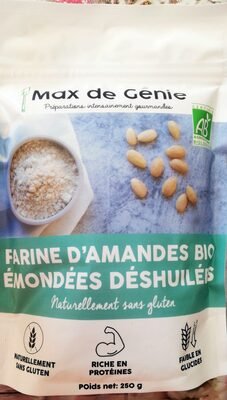
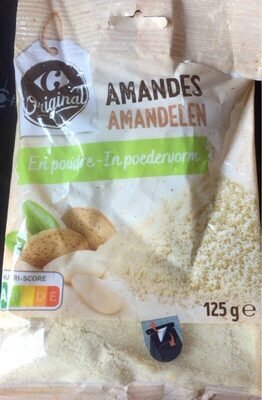
The same goes for U ground almonds, whose label mentions possible traces of cereals containing gluten. Both packets contain nothing but almonds; only the bottom line sets them apart.
Photos and ingredient lists: Open Food Facts, a collaborative open-licence database, retrieved on 8 October 2026. Recipes change: the label on the packet in your hand is what counts.
The table
| No particular risk | To check | Avoid or contains gluten |
|---|---|---|
| Almond flour or ground almonds labelled “gluten free” | Ground almonds with no label at all | Ground almonds with a gluten traces warning |
| Plain whole almonds, ground at home | Almond-based baking mixes | Classic almond financiers, tuiles and biscuits |
| Marzipan, flaked almonds, flavoured almonds | Loose ground almonds |
How to choose
- Read the traces line first. On ground almonds, that’s what makes the difference; the ingredient is always the same. Our article on “may contain” warnings explains what they’re worth.
- Prefer the “gluten free” label, governed by Commission Implementing Regulation (EU) No 828/2014: no more than 20 mg/kg in the finished product.
- The Crossed Grain symbol adds an independent audit; see what each logo is worth.
- For everyday baking (bread, cakes), the lowest-risk option is a labelled almond flour and dedicated utensils.
In short
- Almonds contain no gluten; they’re a tree nut, an allergen for other reasons.
- The risk is factory traces: several supermarket ground almonds warn of them.
- “Almond” products (financiers, tuiles, galettes) often contain wheat flour.
- For a coeliac: a “gluten free” label ideally, and never a gluten traces warning.
Two identical packets in the baking aisle? The Nutrixe scanner reads the traces line, the one that sets one bag of ground almonds apart from another. Discover the app.
See also: cornstarch, buckwheat, and the list of foods with and without gluten.
Sources
- Regulation (EU) No 1169/2011 on the provision of food information to consumers, Annex II: cereals containing gluten and tree nuts, including almonds, among the allergens that must be declared.
- Commission Implementing Regulation (EU) No 828/2014 of 30 July 2014: the “gluten-free” claim is reserved for foods containing no more than 20 mg/kg.
- AFDIAG, Lors de vos achats en magasin, afdiag.fr: products with a “may contain traces of…” warning and loose buying advised against.
- Coeliac UK, A guide to grains, November 2024: almonds among naturally gluten-free foods; some flours milled alongside wheat, barley or rye; check there is no precautionary warning.
- Thompson T., Lee A. R., Grace T. Gluten contamination of grains, seeds, and flours in the United States: a pilot study. Journal of the American Dietetic Association, 2010; 110(6): 937–940.
- Open Food Facts, product entries 3770012380397 (Max de Génie Farine d’amandes), 3560071316792 (Carrefour Original Amandes en poudre), 3256225731893 (U Amandes en poudre), 3179142054633 (Vahiné Amandes en poudre), 3256222626895 (U Financiers aux amandes) and 3256220065641 (U Tuiles aux amandes), consulted on 8 October 2026.
This information is no substitute for medical advice. How strict you need to be depends on your situation: if you have coeliac disease, talk to your doctor or to a patient association such as Coeliac UK or, in the US, the Celiac Disease Foundation.


