Nutrixe
Chickpea flour has no gluten by nature: it is ground chickpeas, a pulse. But two of the three chickpea flours we looked at for this article warn of possible traces of gluten, and the “besan” on an Indian grocer’s shelf is not always pure chickpea. The plant is safe; the mill is what you need to check.
A pulse flour
The chickpea is not a cereal. Its proteins have nothing in common with those of wheat, barley and rye, the only ones that trigger the coeliac reaction. Coeliac UK lists gram flour (besan), made from ground chickpeas, among flours suitable for a gluten-free diet, along with the other pulses we cover in our article on lentils and pulses.
It carries a good part of the Mediterranean and Indian repertoire:
- Socca from Nice, a thin pancake baked in the oven, and its cousin farinata from Liguria, called cecina or torta di ceci in Tuscany.
- Panisse from Marseille, a set chickpea-flour porridge cut into sticks, then fried or pan-fried, and Sicilian panelle, also fried.
- Pakoras and bhajis, whose batter is made with gram flour.
- Falafels, made from soaked chickpeas rather than flour, but often bound with a flour.
What’s still at risk
The mill
A flour keeps the dust of the mill it was ground in. Coeliac UK says it for all these flours: some are milled in the same place as wheat, barley or rye, and a pack with a “may contain” warning for cereals containing gluten should be avoided. The Italian coeliac association (AIC) classes chickpea flour as an “at risk” food, to be bought only with the “gluten free” label.
Testing bears this out. Health Canada analysed 640 naturally gluten-free flours and starches bought between 2010 and 2012: 61 were above 20 mg/kg of gluten, or 9.5%, with a maximum close to 8,000 mg/kg. Of the 268 labelled gluten free, only 3 were above that threshold. Our article on contamination in quinoa, rice and corn explains the mechanism, from field to mill.
Besan from Indian grocers
Besan from Indian grocers raises two more questions. First, what’s in it: the name means chickpea flour, but the Koh-i-Noor bag below blends yellow split peas and chickpeas. Second, the supply chain: in southern India, a study published in 2020 found more than 20 mg/kg of gluten in 35.9% of the flours made from naturally gluten-free grains it analysed, mostly unbranded flours bought at the market or straight from the mill. An imported bag is read like any other, “may contain” line included. For asafoetida, the other trap in this cuisine, see our article on Indian food.
Ready meals and the counter
A “chickpea” batter is only wheat free if all its flours are. Onion bhajis from the British chain Asda are an example: their batter combines chickpea flour, rice flour, maize flour… and wheat flour, and the scanner answers “Contains gluten”. The same goes for supermarket falafels, often bound with wheat flour or breadcrumbs: our article on kebabs and falafel found several.
At the counter, socca and panisse are wheat free in their recipe, not necessarily in their surroundings: airborne wheat flour from the pissaladière, shared frying oil for panisse and panelle. Our guides to the French Riviera, Tuscany and Sicily give the questions to ask.
Three bags, three answers
These products were recorded in France, except the besan, recorded in the UK.
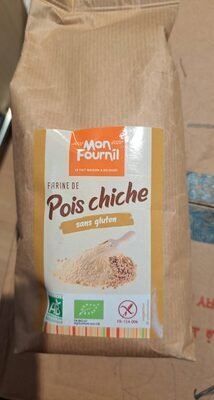
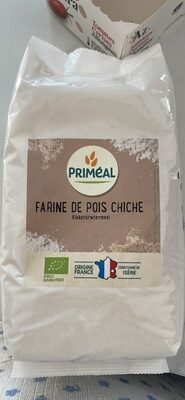
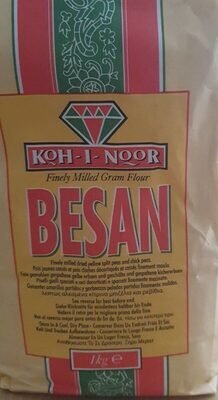
Carrefour Bio’s organic chickpea flour says the same as Priméal’s: “may contain traces of gluten, soya, nuts and sesame seeds”. One single ingredient in all three French bags; it’s the line after it that changes everything.
Photos and ingredient lists: Open Food Facts, a collaborative open-licence database, retrieved on 16 November 2026. Recipes change: the label on the packet in your hand is what counts.
The table
| No particular risk | To check | Avoid or contains gluten |
|---|---|---|
| Chickpea flour labelled “gluten free” or with the Crossed Grain | Chickpea flour with no label at all | Flour with a gluten traces warning |
| Dried chickpeas sorted and rinsed, or plain tinned chickpeas | Besan from a grocer: composition and traces | Bhajis, pakoras or falafels bound with wheat flour |
| Socca, panisse, farinata at the counter (flour, oven, fryer) | Loose chickpea flour | |
| Chickpea “bread” or “pancake” mixes |
How to choose
- Look for the “gluten free” label. Commission Implementing Regulation (EU) No 828/2014 reserves it for products containing no more than 20 mg/kg of gluten: on a flour, it tells you the mill has been checked.
- The Crossed Grain symbol adds an independent audit: see what each logo is worth.
- Rule out traces warnings. Coeliac UK advises against them; see our article on “may contain” warnings.
- No loose flour. Shared scoops and bins next to wheat flour: French coeliac association AFDIAG advises against it too.
In short
- Chickpea flour is a pulse flour: no gluten in the plant.
- The risk is the mill: Priméal and Carrefour Bio warn of gluten traces.
- Besan is read like any flour: composition and the traces line.
- Socca, panisse, falafel, bhajis: the recipe may be wheat free, the counter and the fryer need checking.
Two bags of chickpea flour, same ingredient? The Nutrixe scanner also reads the traces line, and tells the Crossed Grain apart from a manufacturer's own claim. Discover the app.
For other wheat-free flours: chestnut flour, almond flour, buckwheat and gluten-free bread.
Sources
- Coeliac UK, A guide to grains, November 2024: gram flour (besan), from ground chickpeas, and pulses among foods suitable for a gluten-free diet; some flours may be milled in the same place as wheat, barley or rye; avoid products with a “may contain” warning for cereals containing gluten.
- Associazione Italiana Celiachia, L’ABC della dieta del celiaco: chickpea flour (“farina di ceci”) among at-risk foods, to be chosen with the “senza glutine” label. Consulted on 16 November 2026.
- Koerner T. B. et al., Gluten contamination of naturally gluten-free flours and starches used by Canadians with celiac disease, Food Additives & Contaminants: Part A, 2013; 30(12): 2017–2021 (Health Canada): 61 of 640 samples above 20 mg/kg; 3 of 268 among those labelled gluten free.
- Raju N. et al., Gluten contamination in labelled and naturally gluten-free grain products in southern India, Food Additives & Contaminants: Part A, 2020; 37(4): 531–538.
- AFDIAG, Lors de vos achats en magasin: products with a “may contain traces of…” warning and loose buying advised against. Consulted on 16 November 2026.
- Commission Implementing Regulation (EU) No 828/2014: the “gluten-free” claim is reserved for foods containing no more than 20 mg/kg of gluten.
- Open Food Facts, product entries 3760130560900 (Mon Fournil chickpea flour), 3380390134408 (Priméal chickpea flour), 3560071422813 (Carrefour Bio chickpea flour), 5018684000006 (Koh-i-Noor besan) and 5052449525762 (Asda onion bhajis), consulted on 16 November 2026.
This information is no substitute for medical advice. How strict you need to be depends on your situation: if you have coeliac disease, talk to your doctor or to a patient association such as Coeliac UK or, in the US, the Celiac Disease Foundation.