 Nutrixe
A gluten-free kebab isn’t just a kebab without bread. That’s the common belief: skip the wrap, ask for a box, problem solved. It isn’t that simple, because the doner meat can contain rusk, falafel is often bound with wheat flour, and the chips may share the oil with everything else. Here is what you need to know, item by item, and the rare places where a kebab really is gluten free.
Doner meat: what’s in the spit
A doner spit isn’t necessarily a single piece of meat. It is often a combination of slices and minced meat, seasoned and sometimes bound.
In Germany, the name is regulated. The official guidelines for meat products (the Leitsätze, section 2.511.7), as set out by the food safety authority of Lower Saxony, describe “Döner Kebab” as slices of beef, veal or lamb with at most 60% minced meat, seasoned with salt, spices and possibly eggs, onions, oil, milk and yoghurt. If a manufacturer adds breadcrumbs, soya protein or poultry, it must say so in the product name, for example “Döner Kebab mit Paniermehl”. In other words, in Germany a product sold simply as “Döner Kebab” shouldn’t contain breadcrumbs; if it does, the name must say so. You still need to see the label on the spit.
Elsewhere, there’s no such rule. On the product records we checked on Open Food Facts on 25 September 2026:
- in the UK, Jahan cooked and sliced doner meat contains wheat rusk, and Grill House spicy doner meat contains wheat flour;
- in France, Carrefour kebab strips contain barley malt extract, Isla Délice’s contain wheat breadcrumbs, and Auchan’s contain wheat starch;
- on the other hand, Lidl and U kebab strips in France list no gluten ingredient (both warn of possible traces of gluten), and Hacendado’s kebab filling in Spain is bound with rice flour.
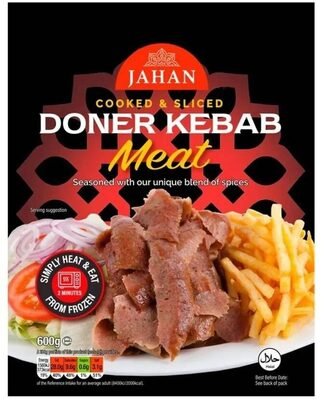

These aren’t the spits used in takeaways, which have their own suppliers, but they show that you can’t guess: the same “kebab meat” may or may not contain gluten depending on the manufacturer. At the counter, the only useful question is: “Can you show me the label from the spit, or tell me what’s in it?” A serious shop has its supplier’s specification sheet.
And even with a gluten-free spit, the sliced meat may fall into the same tray as meat that has touched the bread, or be reheated on the griddle where the wraps are toasted.
Bread and wraps
No surprises here: pitta, Turkish bread (pide), rolled wraps (dürüm, lavash) and Lebanese saj are all made with wheat flour in their classic versions. Bulgur and couscous served on the side, or in tabbouleh, are wheat too; our article on seitan, couscous and bulgur covers these grains.
Ordering a “kebab box” removes the bread, not the contact. In a standard takeaway, your box is filled on the same counter as the wraps, with the same tongs. For someone with coeliac disease, a box from an ordinary kebab shop is still food prepared next to wheat.
Is falafel gluten free?
Falafel is made from soaked chickpeas (or broad beans, in Egypt), blended with onion, herbs and spices, then fried. The basic recipe contains no wheat. But to hold together in the fryer, many recipes add a binder, and it’s often wheat.
Supermarket falafels show this clearly. On the product records we checked on Open Food Facts on 25 September 2026, Cauldron’s Middle Eastern falafels (UK) contain wheat flour and breadcrumbs, and other Cauldron falafels contain bulgur wheat; in France, Garden Gourmet’s contain breadcrumbs, and those from Marque Repère, U and Sensation contain wheat flour. Others do without: goodlife falafel in the UK lists chickpea, onion, oil, parsley and spices, and Florentin’s organic falafels and Lidl’s Vemondo falafels (bound with rice flour) list no wheat.
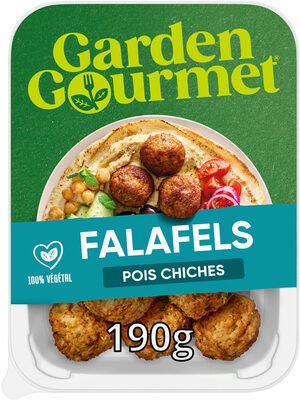

No wheat in the recipe
Good starting points
- Hummus, moutabal, baba ganoush
- Grilled skewered meat, without a doubtful marinade
- Salads, without croutons or bulgur
- Gram-flour falafel, if the fryer is separate
- Rice, grilled vegetables
Check or avoid
Where wheat hides
- Pitta, dürüm, Turkish bread, saj, lavash
- Doner meat: rusk or flour possible
- Falafel bound with flour, breadcrumbs or bulgur
- Bulgur tabbouleh, couscous
- Chips and falafel from the shared fryer
And in a takeaway, falafel may be fried in the same oil as nuggets or battered food. Even a flour-free falafel then becomes a contaminated one. It’s the mechanism we explain for chips.
Photos and ingredient lists: Open Food Facts, a collaborative open-licence database, retrieved on 26 September 2026. Recipes change: the label on the packet in your hand is what counts.
Hummus and sauces
Hummus is the most reassuring part of the meal: chickpeas, tahini (sesame paste), lemon, garlic, olive oil. No wheat. Again, the risk is around it: hummus served with pitta laid on top, or scooped from the same tub that bread is dipped into. For chilled hummus, the ingredient list settles it. Moutabal and baba ganoush (aubergine, tahini) follow the same logic.
Kebab sauces (garlic, chilli, burger sauce) are prepared products, often industrial. Read them like any processed food, and at the counter, ask to see the jar.
The 100% gluten-free kebab shops that exist
They are rare, recent, and almost always born of a personal story. In our listings:
- In Freiburg (Germany), M&K Döner (4.6★) opened in February 2026, founded by a father whose daughter has coeliac disease: doner, pizza, nuggets and chips, all gluten free. Only the beer contains gluten, and the listing carries the matching warning.
- In Visp (Valais, Switzerland), Döner Hüs (4.9★) has served meat or falafel doners in gluten-free flatbreads since May 2026.
- In Warsaw, Patila Döner Kebap (4.6★, nearly 1,500 reviews) describes itself as Poland’s first 100% gluten-free kebab shop, certified under the Polish coeliac association’s “Menu Bez Glutenu” programme: meat, bread and sauces made on site.
- In Poznań, the restaurant Gluten Free, run by an owner with coeliac disease, serves kebabs from a kitchen with a dedicated fryer.
For Lebanese and Levantine food, there are a few more. In Paris, La Sajerie (4.8★, over 600 reviews) makes 100% gluten-free Lebanese street food: saj, hummus, labneh, moutabal. In Valencia, El Miracle (4.6★, nearly 3,200 reviews) blends Mediterranean and Middle Eastern cooking in a kitchen certified by the Valencian coeliac association (FACE network), with separate fryers and utensils. In Los Angeles and Raleigh, Levant Bistro + Bake Shop and Levant Bistro serve entirely gluten-free Levantine food; the Los Angeles bake shop even makes gluten-free pitta. In Brussels, The Sister, near the Grand-Place, has falafel on an entirely gluten-free menu.
Two listings show what a mixed kitchen looks like. In Valencia, Somni (4.9★) serves hummus, falafel and kebabs with dish-by-dish allergen labelling, but its menu lists cereals containing gluten: we list it under “options”, with cross-contamination and flour warnings. In Colmar, Cuit lu Cru offers kebabs on a mostly gluten-free menu, but the kitchen isn’t dedicated.
What to ask at the counter
In an ordinary takeaway with no dedicated kitchen, four questions help you judge:
- “What’s in the spit? Can you show me the label?”
- “Is the falafel made with flour or breadcrumbs?”
- “Are the chips and falafel fried in the same oil as breaded food?”
- “Can you prepare my plate with clean tongs and a clean board?”
If the answers are hesitant, hummus and salad remain the least risky options, with no guarantee. For the rest, the principles in our guide to eating out with coeliac disease apply, and the Nutrixe map lists verified places. Know a gluten-free kebab shop we’re missing? Suggest it.
In short
- Skipping the bread isn’t enough: the meat, the falafel and the fryer can all bring gluten.
- In Germany, a “Döner Kebab” can’t contain breadcrumbs without saying so; in the UK, some doner meats contain rusk or wheat flour.
- Falafel is often bound with wheat flour, breadcrumbs or bulgur; classic hummus is gluten free.
- 100% gluten-free kebab shops exist, mostly in Germany, Switzerland and Poland.
- At the counter, ask for the spit label, the falafel recipe and the fryer.
This information does not replace medical advice. The compositions quoted come from labels checked in September 2026; every manufacturer and every takeaway has its own recipes, and they change. The label or the shop's precise answer is what counts.


