Nutrixe
It is the most efficient hidden gluten in world cuisine: a dark, salty liquid nobody suspects, poured over dishes that otherwise have nothing to answer for. Classic soy sauce contains wheat, not as a trace, but as a main ingredient.
How soy sauce is made
Japanese shoyu is brewed with soy and roasted, crushed wheat in almost equal proportions, inoculated with a ferment (kōji), then left to ferment in brine for months. Wheat provides the sugars that feed the fermentation and part of the aroma. Common Chinese soy sauces follow a similar logic, with wheat or wheat flour.
Result: on the bottle, the order of ingredients is generally “water, soybeans, wheat, salt”. Wheat is the second or third ingredient. Fermentation does not make it disappear: analyses find gluten well above 20 ppm in classic sauces.
Tamari: the right lead, without guarantee
Tamari comes from a different tradition, that of miso: it is brewed with soy and little or no wheat. That is why it is recommended to people with celiac disease, and it is generally a good lead.
But “tamari” is a word, not a standard. Nothing prevents a manufacturer from selling under that name a sauce containing some wheat, and it happens. The only thing that counts is the regulated “gluten-free” claim on the label, which commits the manufacturer to a content below 20 ppm. Our guide to reading gluten-free labels explains the difference between what a word says and what a claim guarantees.
Three bottles from one brand, three answers
Nothing illustrates the problem better than a single brand, the most widespread in the world, whose bottles look alike and do not say the same thing:
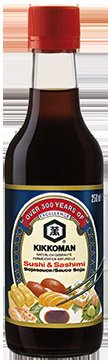
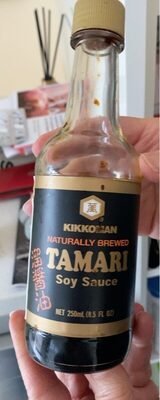
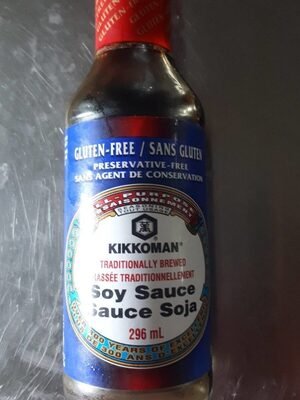
Photos and ingredient lists: Open Food Facts, a collaborative open-licence database, retrieved on 5 September 2026. Recipes change: the label on the bottle in your hand is what counts.
Where soy sauce hides
It is not only the bottle on the table. Soy sauce goes into:
- marinades (teriyaki, yakitori, glazed meats);
- compound sauces: ponzu, sushi sauce, “Asian” salad dressing, stir-fried noodle sauce, hoisin (often), some prepared fish sauces;
- braised dishes and ramen broths;
- unexpected Western products: barbecue sauces, Worcestershire sauces, some stock cubes, “Asian-style” ready meals.
Our article on sushi and Japanese food goes round the whole table; this one focuses on the ingredient.
What Nutrixe listings say
The “soy sauce” flag is one of the risks we record establishment by establishment. It appears on 9 listings so far, and they illustrate both situations.
On one side, Asian kitchens that are entirely gluten-free, which settled the question at the source by working only with a wheat-free sauce: Asian Box in California, Foo Dog Curry Traders in Florida, POKE by Love Art in Boston. On the other, kitchens that advertise “gluten free” but whose menu mentions classic shoyu with no stated alternative, as at RICE Healthy Japanese Dining, cautiously classed as “options” rather than dedicated. In Monaco, Planet Sushi marks gluten-free dishes and offers a gluten-free soy sauce on request: an adapted menu, not a dedicated kitchen, and the listing says so.
The reflexes
- In a restaurant: “Do you have a gluten-free soy sauce?” If the answer is no or hesitant, sashimi and plain rice remain safe without sauce, and everything marinated or glazed is not.
- The bottle in the bag: many celiac travellers keep a small certified “gluten-free” tamari. It replaces the table sauce without asking the kitchen anything, and it solves the problem in most Asian restaurants in the world.
- On the shelf: look for the “gluten-free” claim, not the word “tamari”.
- In Japanese: “Kono shōyu wa komugi ga haitte imasu ka?” — does this soy sauce contain wheat? And to say you have celiac disease: “Watashi wa seriakku-byō desu”.
In short
- Classic soy sauce = soy + wheat: it contains gluten.
- Tamari = traditionally wheat-free, but the word guarantees nothing; only the “gluten-free” claim counts.
- It hides in marinades, compound sauces and Western products.
- A bottle of certified tamari in the bag settles 90% of situations.
- On the Nutrixe map, the “soy sauce” flag marks the kitchens where the question came up.
Scan the bottle. The Nutrixe scanner reads a soy sauce's ingredient list and spots the wheat, even written in small print after the soy. Discover the app.