Nutrixe
Millet, teff, sorghum, fonio and amaranth have no gluten by nature. Coeliac UK lists them all among the foods suitable for a gluten-free diet. But these small grains go through mills and factories that also handle wheat: of three packets we looked at in France, the two teff flours carry a “gluten free” claim, while the hulled millet warns of traces.
Five grains, no gluten cereal
Gluten comes from three cereals: wheat, barley and rye. None of the five grains in this article is one of them. Coeliac UK, the UK coeliac charity, lists all of them among suitable foods, and AFDIAG, the French coeliac association, names millet and sorghum among the gluten-free cereals.
- Millet: small round yellow grains, sold hulled, as flakes, as flour or puffed. Coeliac UK also calls it bajra, the name it goes by in India: our article on Indian food covers the rest of the menu.
- Teff: a grass with tiny seeds, the grain of Ethiopian injera, sold mostly as white or wholegrain flour.
- Sorghum: a cereal sold as grain or flour. Sorghum malt is used to brew gluten-free beers: our guide to gluten-free beer tells them apart from gluten-reduced ones.
- Fonio: a small grain eaten mostly in West Africa.
- Amaranth: a pseudo-cereal from the same family as quinoa, sold as seeds, flour or puffed.
For teff there is even clinical data: a 2006 survey of 1,545 Dutch people with biopsy-proven coeliac disease concluded that the vast majority of those who eat teff do so without symptoms.
What’s still at risk
The mill and the factory
It’s the same mechanism as for rice, corn and quinoa, explained in our article on cross-contamination in the supply chain: neighbouring fields, combine harvesters, silos, and above all mills shared with wheat. A 2010 US study analysed 22 naturally gluten-free grains, seeds and flours sold without a gluten-free label: 7 were at 20 mg/kg or more, and the most contaminated reached 2,925 mg/kg.
Coeliac UK points out that some of these flours are milled in the same place as wheat, barley or rye, and that a product carrying a “may contain” warning for gluten cereals should be avoided. AFDIAG also advises against loose bulk bins, where scoops and containers are shared.
Flours and flakes are the most exposed, because they have been through a mill or a flaking roller. Hulled grain is less exposed, but not exempt: the millet below shows it.
Injera
Injera, the large fermented flatbread of Ethiopian cuisine, is traditionally made from teff. But a study of Ethiopian households found three flour blends: teff and white sorghum, barley and wheat, and wheat and red sorghum, the last two with barley malt. So injera is not gluten free by definition; in a restaurant, ask what it’s made of, and whether it’s cooked on the same griddle as the others.
Blends
A packet of “ancient grains”, a millet muesli or a bread mix may combine millet, spelt and oats. The grain in the name is not the only one: the ingredients list gives them all.
The Nutrixe scanner doesn’t count any of these five grains as a gluten cereal. What it reads to decide is the declared allergens, the “gluten free” claim, a certification logo and the traces line.
Three packets, three answers
These three products are sold in France.
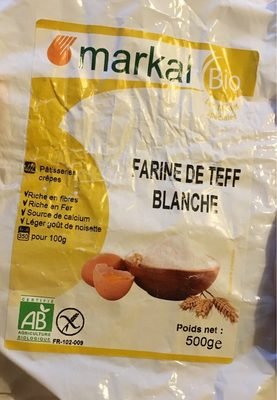
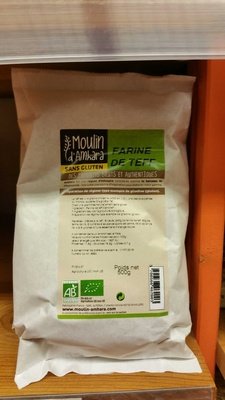
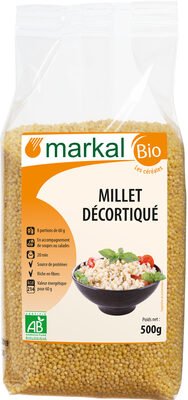
Markal isn’t an isolated case: La Vie Claire hulled millet and Lidl’s Golden Sun organic golden millet also warn of traces of gluten, the latter specifying “wheat, oats”.
Photos and ingredient lists: Open Food Facts, a collaborative open-licence database, retrieved on 16 November 2026. Recipes change: the label on the packet in your hand is what counts.
The table
| No particular risk | To check | Avoid or contains gluten |
|---|---|---|
| Millet, teff, sorghum, fonio or amaranth labelled “gluten free” or with the Crossed Grain | Grains and flours with no label at all | Packets with a gluten traces warning |
| Injera in a restaurant: which flours, which griddle? | Loose bulk bins | |
| “Ancient grain” blends, millet mueslis | Blends with spelt, wheat, barley or rye |
In short
- Millet, teff, sorghum, fonio, amaranth: no gluten by nature, according to Coeliac UK.
- The risk is the mill: several millets on French shelves warn of gluten traces.
- Flours and flakes: always labelled “gluten free”. Avoid loose bulk bins.
- Injera can contain wheat or barley: ask.
Two bags of millet, same ingredient? The Nutrixe scanner reads the traces line and tells the Crossed Grain from a simple claim, so you know which one has been checked. Discover the app.
For other gluten-free grains: buckwheat, quinoa, tapioca, chia and flax seeds and what each logo is worth.
Sources
- Coeliac UK, A guide to grains, November 2024: amaranth, fonio, millet (bajra), sorghum (whose malt is used in gluten-free brewing) and teff among the foods suitable for a gluten-free diet; some flours may be milled in the same place as wheat, barley or rye; a product carrying a “may contain” warning for gluten cereals should be avoided.
- AFDIAG, Lors de vos achats en magasin: millet and sorghum among the gluten-free cereals; loose bulk buying and products with a “may contain traces of gluten” warning advised against. Accessed 16 November 2026.
- Commission Implementing Regulation (EU) No 828/2014: the “gluten free” claim is reserved for foods containing no more than 20 mg/kg of gluten.
- Thompson T., Lee A. R., Grace T., Gluten contamination of grains, seeds, and flours in the United States: a pilot study, Journal of the American Dietetic Association, 2010; 110(6): 937–940.
- Hopman E. et al., Tef in the diet of celiac patients in The Netherlands, Scandinavian Journal of Gastroenterology, 2008; 43(3): 277–282.
- Baye K. et al., Influence of flour blend composition on fermentation kinetics and phytate hydrolysis of sourdough used to make injera, Food Chemistry, 2013; 138(1): 430–436.
- Open Food Facts, product entries 3329486565009 (Markal, teff flour), 3700566462003 (Moulin d’Amhara, teff flour), 3329482411201 (Markal, hulled millet), 3266191107110 (La Vie Claire, hulled millet) and 4056489658450 (Golden Sun, golden millet), accessed 16 November 2026.
This information is no substitute for medical advice. How strict you need to be depends on your situation: if you have coeliac disease, talk to your doctor or to a patient association such as Coeliac UK.