Nutrixe
Yes, rye contains gluten. It’s one of the three cereals to avoid with coeliac disease, alongside wheat and barley. It’s easy to spot on a packet, because the law requires it to be emphasised. What’s harder to spot is what comes with it: a “rye” loaf can contain more wheat than rye.
Secalin, the gluten in rye
Each gluten cereal has its own protein: gliadin in wheat, hordein in barley, secalin in rye. All three trigger the autoimmune reaction of coeliac disease; our article on barley covers this family and the Codex Alimentarius standard that defines it. Coeliac UK lists rye among the foods that are not suitable, noting that it is closely related to barley and wheat.
In Europe, Regulation (EU) No 1169/2011 lists rye among the cereals containing gluten, which must be emphasised in the ingredients list. AFDIAG, the French coeliac association, and France’s national health insurance list it among the forbidden cereals.
“Less gluten than wheat”?
It’s one of the most searched questions about rye, in every language. For a coeliac, quantity isn’t the point: secalin is enough to trigger the reaction, and the “gluten free” claim requires no more than 20 mg of gluten per kilo (Commission Implementing Regulation (EU) No 828/2014). Rye bread isn’t “a little bit” gluten free, and no patient association makes an exception for it.
The same goes for sourdough: a naturally leavened rye bread is still a gluten bread, as our guide to gluten-free bread explains.
Where rye turns up
Rye bread and “rye” bread
A bread’s name refers to its headline cereal, not to all the others. The Carrefour “rye” loaf below contains 34% wheat flour against 30% rye, plus barley malt extract: three gluten cereals in a bread that names only one. Wholemeal rye, dark rye, Nordic-style bread, Scandinavian crispbreads and rye crackers are read the same way.
Pumpernickel
Pumpernickel is a dark German bread made from cracked rye grains. The one from Pural, below, contains nothing but rye, water, salt, sourdough and yeast: that’s enough to make it a gluten bread. Lidl’s adds barley malt extract. Our guide to gluten-free travel in Germany shows how central rye is to German baking, and the one on Poland does the same for Polish baking.
Gingerbread and pain d’épices
Many French pains d’épices, the honey-and-spice loaves sold in every supermarket, are made with rye flour, sometimes with no wheat at all: that’s the case at Jardin Bio and La Vie Claire. “Wheat free” doesn’t mean gluten free: the loaf below is an example, and spiced breads are among the treats to watch at Christmas markets.
Triticale
Triticale is a cross between wheat and rye. Coeliac UK, AFDIAG and France’s national health insurance all list it among the cereals to avoid. Our article on seitan, kamut and wheat under other names covers these false friends.
Rye whiskey
Rye whiskey is distilled from rye. Distillation leaves the gluten behind in the still, and EU law exempts cereals used for distillates from allergen labelling. The detail, and the exceptions (liqueurs, premixes, beer), are in our article on whisky, vodka and gin.
The Nutrixe scanner reads rye in the app’s six languages (rye, seigle, Roggen, centeno, segale, centeio), as well as triticale, and it reads the traces line too.
Three packets, the same answer
These three products are sold in France.
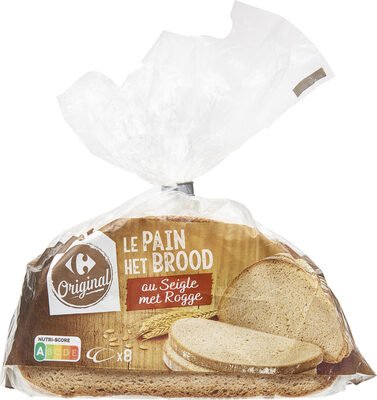
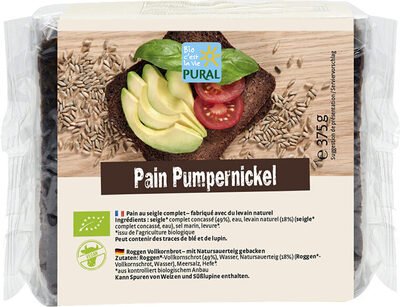

Photos and ingredient lists: Open Food Facts, a collaborative open-licence database, retrieved on 16 November 2026. Recipes change: the label on the packet in your hand is what counts.
The table
| Gluten free (check for traces) | To check | Contains gluten |
|---|---|---|
| “Rye-style” bread labelled “gluten free” | Spiced bread labelled “gluten free”: what is it made of? | Rye bread, “rye” bread, wholemeal or dark rye |
| Buckwheat, rice, corn, millet, quinoa flour labelled “gluten free” | Flavoured whisky, whisky liqueur or premix | Pumpernickel, rye crispbreads |
| Pure whisky, even rye (distilled) | Rye flour and flakes, triticale | |
| Gingerbread and pain d’épices made with rye or wheat |
What to use instead
For a dark, dense slice, buckwheat and teff are two flours with no gluten by nature; in Poland, dedicated bakeries even sell “rye bread” without any rye. These flours should still be bought labelled “gluten free”: see buckwheat, millet and teff and cross-contamination in quinoa, rice and corn.
In short
- Rye contains gluten: secalin, as harmful to a coeliac as wheat’s gliadin.
- “Less gluten” or “sourdough”: makes no difference for a coeliac.
- A “rye” loaf can contain more wheat than rye, and barley malt.
- Pumpernickel, rye-based spiced bread, triticale: rye under other names. Pure whisky is the exception, thanks to distillation.
Roggen, segale, centeno? The Nutrixe scanner reads rye and triticale in six languages, including on a pumpernickel brought back from Germany. Discover the app.
For other cereals: barley, spelt, oats and the list of foods with and without gluten.
Sources
- Codex Alimentarius, Standard for foods for special dietary use for persons intolerant to gluten (CXS 118-1979, revised 2015) (copy hosted by the Finnish Food Authority): secalin, the prolamin of rye, among the gluten proteins. Accessed 16 November 2026.
- Regulation (EU) No 1169/2011, Annex II, point 1: rye among the cereals containing gluten, to be emphasised; exemption for cereals used for making alcoholic distillates.
- Commission Implementing Regulation (EU) No 828/2014: the “gluten free” claim is reserved for foods containing no more than 20 mg/kg of gluten.
- Coeliac UK, A guide to grains, November 2024: rye, “closely related to barley and wheat”, and triticale, “a cross between wheat and rye”, among the foods not suitable for a gluten-free diet.
- AFDIAG, Lors de vos achats en magasin: rye and triticale among the cereals containing gluten. Accessed 16 November 2026.
- Assurance Maladie (ameli.fr), Régime alimentaire sans gluten en cas de maladie cœliaque: rye and hybrids of these cereals, such as triticale, a cross between wheat and rye. Accessed 16 November 2026.
- Open Food Facts, product entries 3560070879762 (Carrefour, rye bread), 3184340065022 (Pural, pumpernickel), 3760020503994 (Jardin Bio étic, pain d’épices), 3266191008493 (La Vie Claire, pain d’épices) and 4056489026051 (Lidl, pumpernickel), accessed 16 November 2026.
This information is no substitute for medical advice. If you have coeliac disease, your diet should be worked out with your doctor or a dietitian, and a patient association such as Coeliac UK can support you.