 Nutrixe
Yes, you can eat Chinese, Thai or Vietnamese food with coeliac disease, but not by trusting the rice. Rice and rice noodles contain no gluten; what gets poured over them often does: soy sauce, oyster sauce, hoisin, not to mention wheat noodles, dumplings and the shared fryer. Here is what works, what needs checking, and the places where the question disappears.
Why Asian restaurants catch people out
Three mechanisms explain almost every slip.
The sauces. Classic soy sauce is brewed with wheat, in almost equal parts with soya; our article on soy sauce and tamari explains why. The problem is that it doesn’t stay in the bottle: it goes into oyster sauce, hoisin, marinades and glazes. A “plain” vegetable stir-fry with a spoonful of oyster sauce is no longer gluten free.
The doughs. Egg noodles, wheat noodles, steamed dumplings, gyoza, Chinese spring rolls, bao buns: the dough is almost always wheat.
The kitchen itself. A wok may be used for everything and simply rinsed between dishes. The fryer may cook prawn toast, spring rolls and battered chicken in the same oil. Coeliac UK sums it up for Chinese takeaways: avoid wheat noodles and soy sauce, and watch for shared cookware and oil, including for meat and vegetables that are naturally gluten free.
The sauces, one by one
This is the most useful part of the article, because it applies to every East and South-East Asian cuisine.
| Sauce | What the label usually says | Verdict |
|---|---|---|
| Soy sauce (light, dark, shoyu) | Soya, wheat, salt | Avoid, unless labelled gluten free |
| Oyster sauce | Often wheat flour or soy sauce | Check brand by brand |
| Hoisin | Fermented soya paste with wheat flour, almost always | Avoid, unless labelled gluten free |
| Fish sauce (nam pla, nuoc mam) | Usually anchovy, salt, sugar | Usually wheat-free, still read it |
| Thai curry pastes | Chilli, lemongrass, galangal, shrimp | Rarely wheat, still read it |
| Tamari labelled gluten free | Soya, salt, sometimes rice | Safe |
Oyster sauce shows the trap well, because two similar bottles don’t say the same thing. On the product records we checked on Open Food Facts on 25 September 2026, the 255 g bottle of Lee Kum Kee “Panda” oyster sauce contains wheat flour, while another Panda product sold in France, the 510 g bottle, contains none, and Ayam oyster sauce uses rice flour instead; Sainsbury’s own oyster sauce lists no wheat. In a restaurant, you cannot know which bottle is in the cupboard. Hoisin is simpler: the versions we checked from Amoy, Sharwood’s and Sainsbury’s, and some of Lee Kum Kee’s (other products from the brand use a soy sauce made with maize starch), contain wheat flour in their soya paste, as does the Blue Dragon hoisin sold in the UK (the Swedish version of the same brand swaps the wheat for rice). In a restaurant, treat hoisin as containing gluten. The red curry pastes we checked (Mae Ploy, Cock, Thai Kitchen, Ayam, among others) contain no wheat.
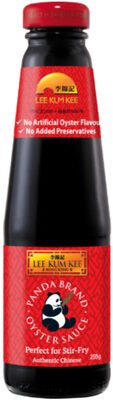
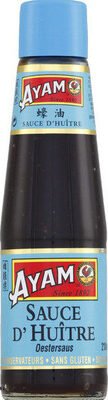
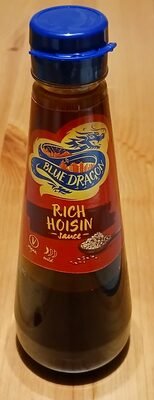

A recipe can change from one country or year to the next. The ingredient lists and photos shown here come from Open Food Facts, a collaborative open-licence database, in September 2026. Only the label on the product in front of you counts, and in a restaurant, only the kitchen’s answer.
At a Chinese restaurant
Of the three cuisines, this is where wheat is most present: soy sauce and wheat flour are basic ingredients, not exceptions.
Worth trying, asking each time for “no soy sauce, no oyster sauce, clean wok”: plain boiled rice, vegetables stir-fried with garlic, steamed meat or fish, egg fried rice made without soy sauce. The cornflour used to thicken many sauces is not a problem in itself; it’s what goes with it that is.
Avoid: fried noodles, dumplings and dim sum (wheat dough, unless rice or tapioca wrappers are made specially, which you can ask about), spring rolls, anything battered or breaded, crispy duck (served with wheat pancakes and hoisin), meat glazed or marinated in soy sauce, ready-made sweet and sour sauces.
A fully gluten-free Chinese restaurant is the rarest thing in this article. In our listings, the clearest example is in Brisbane: Noodle Asia (4.3★, over 560 reviews) describes itself as a 100% gluten-free Chinese restaurant, with scrubbed woks and dedicated fryers. In Bordeaux, Madame Pang serves Hong Kong-style dim sum and marks gluten-free dishes on the menu, but its listing carries three warnings: mixed kitchen, shared fryer, airborne flour. A menu that informs is not a kitchen that protects.
Thai food: less wheat, but not zero
Thai cooking starts with an advantage: its basics are rice, rice noodles, coconut milk, herbs and curry pastes, which usually contain no wheat. Pad thai is made with rice noodles; green and red curries with coconut milk.
Wheat comes in through the side door. A pad thai may be seasoned with soy or oyster sauce depending on the kitchen; so may a “holy basil” or “garlic” stir-fry; fried starters may share the oil. So the right question is not “is the green curry gluten free?” but “which sauces go into this dish, and do you have a gluten-free soy sauce?”
Often wheat-free
Order, but check
- Plain steamed or sticky rice
- Coconut curries, once the paste and seasoning are checked
- Pad thai or pho ordered without soy, oyster or hoisin sauce
- Fresh rice-paper summer rolls, without hoisin
- Som tam papaya salad, with the fish sauce checked
Avoid unless the kitchen is dedicated
Often contains wheat
- Egg noodles, ramen, udon, dumplings, bao
- Anything battered, breaded or tempura
- Spring rolls from the shared fryer
- Oyster-sauce stir-fries, glazed meats, teriyaki
- Hoisin and ready-made sweet and sour sauces
Is pho gluten free? Vietnamese food
Vietnamese food is probably the most accessible of the three. Pho is built on rice noodles and a bone broth scented with star anise, cinnamon and fish sauce. Bun bowls combine rice vermicelli, herbs, salad and grilled meat. Summer rolls are wrapped in rice paper.
Three things still need checking. Hoisin, on the table or served with the rolls, almost always contains wheat: ask for it on the side, or not at all. The pho broth may be seasoned with soy sauce depending on the kitchen. And fried spring rolls may be wrapped in rice paper yet fried in the same oil as battered items.
It is also the cuisine with the most fully gluten-free places in our listings. In Montreal, Roll’V (4.6★) serves pho, vermicelli bowls and a gluten-free bánh mì; its listing mentions a certification from Canada’s GFFP programme obtained in 2026. In Calgary, TRE Vietnamese Kitchen (4.8★, over 650 reviews) states on its website that the whole facility is gluten free. In Toronto, Senla and Pho Concept do the same. In Australia, Le Feu in Brighton (4.6★, over 1,500 reviews) serves pho, bao and dumplings and displays Coeliac Australia accreditation.
In Europe, dedicated Vietnamese places are rarer and their listings more nuanced. In Frankfurt, Lúa Cuisine is described by several sources as entirely gluten free, but its official website doesn’t say so directly: the listing carries an “unconfirmed claim” warning, plus one for beer. In Munich, Bep Bu (4.8★, over 900 reviews) marks its gluten-free dishes, but the kitchen is mixed; we list it as a gluten-free menu, not a dedicated kitchen.
Ramen and noodles: the clearest case
Classic ramen is out: the noodles are wheat, and the broth is often seasoned with soy sauce or miso. Udon is wheat too. Soba are sold as “buckwheat” noodles but are often cut with wheat flour; our article on sushi and Japanese food explains that trap.
Gluten-free ramen does exist, but almost only in fully dedicated kitchens that have remade both noodles and broth. In Barcelona, ARUKU (4.7★, over 1,400 reviews) and Kobe serve it. In Milan, Sushi&Sound offers ramen and tempura in a 100% gluten-free kitchen that states its membership of AIC, the Italian coeliac association; in Turin, El Crab Bistrot serves ramen in a fusion kitchen certified by AIC in 2025.
What to ask, and the dedicated places
At the counter, three questions sort out most situations:
- “Which sauces go into this dish: soy, oyster, hoisin?” Not “is it gluten free?”, which invites a polite yes.
- “Do you have a gluten-free soy sauce, and can you use a clean wok?” A place that has one says so straight away.
- “Is the fryer also used for battered food and spring rolls?” If so, nothing fried is safe; it’s the same logic as for chips.
If language is a barrier, a written card to show the waiter helps; ours is in our coeliac restaurant card in several languages. Many coeliac travellers also carry a small bottle of tamari labelled gluten free.
The calmest option is still a kitchen that has removed wheat at the source. In the UK, Bangkok Canteen in Gloucester is an entirely gluten-free Thai restaurant. In Paris, Thaïsil (4.4★, over 500 reviews) has served 100% gluten-free Thai-Cambodian food since 2010. In Montreal, Krapow does the same in the Plateau, and in Toronto, Riz Gluten-Free Asian Kitchen serves gluten-free dim sum and stir-fried noodles. In Switzerland, the small Rice Up! chain makes Asian bowls in dedicated kitchens. The Nutrixe map shows them all, with each listing’s level and warnings.
In short
- Rice and rice noodles are gluten free; soy sauce, hoisin and often oyster sauce are not.
- Chinese: the riskiest (noodles, dumplings, glazes, shared wok). Thai and Vietnamese: more accessible, if you ask about sauces dish by dish.
- Pho: rice noodles, but refuse the table hoisin and check the broth.
- Ramen, udon, bao and dumplings are wheat, except in dedicated kitchens.
- Ask about sauces and the fryer, not “is it gluten free?”.
This information does not replace medical advice. Sauce recipes change by brand and country, and every kitchen works its own way: when in doubt, only the label or the restaurant's precise answer counts. If you know a gluten-free Asian place we are missing, suggest it.


