Nutrixe
A classic galette des rois contains gluten twice over: in its puff pastry, made from wheat flour, and often in its frangipane, thickened with flour. Gluten-free galettes do exist, from dedicated bakeries, in shops or homemade, but you still need to check the filling, the kitchen where it was made and the knife that cuts it.
Where gluten hides in a galette
The puff pastry
It’s most of the galette, and it’s made from wheat flour, water, salt and butter or margarine. On a supermarket frangipane galette, wheat flour is the first ingredient (41.7% on the Lidl Maître Jean Pierre galette below). Gluten-free puff pastry exists, but it’s made differently: corn starch, rice flour, fibres and thickeners replace the wheat.
The frangipane
Strictly speaking, almond cream is made from ground almonds, butter, sugar and eggs: nothing that contains gluten. But pastry chefs’ frangipane is often a mix of almond cream and pastry cream, and pastry cream is thickened with wheat flour or starch depending on the recipe. Ground almonds themselves can carry a gluten traces warning, as we found on several supermarket packets in our article on almond flour.
The couronne des rois
In the south of France, the galette gives way to the couronne or gâteau des rois, a brioche with candied fruit. Brioche dough made with wheat flour: same conclusion, and the same alternatives to look for in dedicated bakeries.
The fève and the glaze
The glaze is egg, which is gluten free; for any icing sugar dusted on top, check where its starch comes from. The fève, nowadays a small porcelain figurine, contains nothing either; but if you slip into a gluten-free galette a fève that has come out of a classic galette, it brings its crumbs with it. Wash it, or keep a dedicated one.
Finding a gluten-free galette
Fully gluten-free bakeries
This is the safest option: no wheat flour comes into the bakery. Not all of them make galettes, and those that do sometimes make them only to order: our selection of 100% gluten-free bakeries in France is the place to start, and a phone call in the first days of January, or even before the holidays, saves a wasted trip. Our article on how to spot a truly gluten-free bakery gives the questions to ask.
Specialist brands
Gluten-free brands sell galettes des rois in organic shops, specialist grocers or frozen. On Open Food Facts, you’ll find them from Nature & Cie or Glutabye, for example, whose dairy-free frangipane galette carries the Crossed Grain according to its entry. Read the claim: “gluten free” written by the manufacturer isn’t a certification.
Ordinary bakeries
Some traditional bakeries offer a “gluten-free” galette in January. For someone who avoids gluten by preference, that’s often enough. For a coeliac person, the question is the bakery itself: airborne flour, shared worktops, ovens and baking trays. In France, since Decree No. 2015-447 of 17 April 2015, a bakery must state the allergens in its unpackaged products in writing; that information covers the recipe, not what’s floating in the air of the bakehouse. Ask where the galette is made.
Two galettes, two answers
These two products are sold in France.
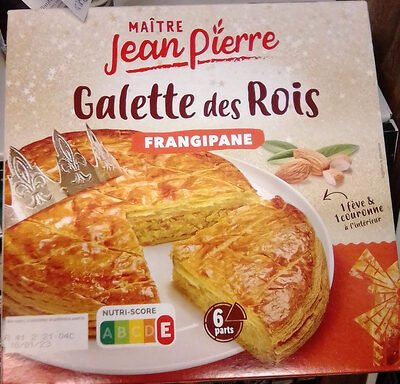
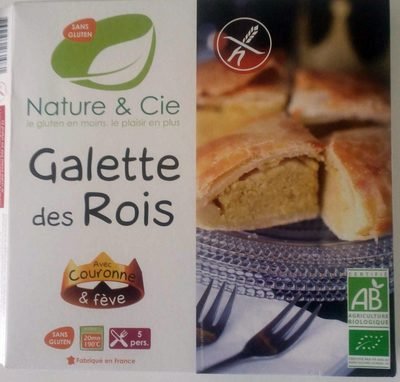
Photos and ingredient lists: Open Food Facts, a collaborative open-licence database, retrieved on 8 October 2026. Recipes and ranges change from one year to the next: the label on the box in your hand is what counts.
Making it yourself
This is the option that leaves the fewest open questions.
- The puff pastry: several gluten-free puff pastries are sold in French supermarkets, some of which carry the Crossed Grain (those from Regain and the U brand, according to Open Food Facts). Their ingredients often include transglutaminase: an enzyme that helps the dough hold together, not gluten, despite its name.
- The filling: ground almonds with no gluten traces warning, butter, sugar, eggs, and if you want a frangipane, a pastry cream thickened with cornstarch labelled “gluten free”.
- The kitchen: a washed worktop, a clean rolling pin and brush, a tin and tray with no flour left on them. Our article on cross-contamination at home covers the rest.
On the day
The galette is meant to be shared, and that’s when precautions go out of the window: the same knife for the classic galette and the gluten-free one, the same dish, the same cake slice. Cut the gluten-free galette first, with a clean knife, and serve it on a separate plate. At the office or at school, bring a whole galette rather than a slice on the shared tray. Our article on dinner at friends’ homes gives other good habits.
The table
| Safer for a coeliac | To check | Contains gluten |
|---|---|---|
| Galette from a fully gluten-free bakery | “Gluten-free” galette from an ordinary bakery | Classic galette des rois (wheat puff pastry) |
| Branded galette with the Crossed Grain | Branded galette with a plain “gluten free” claim | Classic couronne or brioche des rois |
| Homemade galette with labelled pastry and ground almonds | Homemade frangipane: ground almonds, thickener | Slice cut with the classic galette’s knife |
In short
- The classic galette contains gluten in its puff pastry and often in its frangipane.
- The options: a dedicated bakery (call first), specialist brands, or a homemade galette with shop-bought gluten-free puff pastry.
- A “gluten-free” galette from a mixed bakery remains exposed to airborne flour.
- On the day: a clean knife, the gluten-free galette cut first, a washed fève.
In the frozen or bakery aisle? Scan the box: the Nutrixe scanner tells a certified galette from one simply labelled gluten free and from a wheat galette, and shows you the ingredients list. For dedicated bakeries, the app's map lists verified addresses.
For the other winter celebrations: gluten-free Christmas and New Year, Christmas markets and the galette’s Spanish cousin, the roscón de reyes.
Sources
- Regulation (EU) No 1169/2011 on the provision of food information to consumers, Annex II: cereals containing gluten and tree nuts among the allergens that must be declared.
- Commission Implementing Regulation (EU) No 828/2014 of 30 July 2014: the “gluten-free” claim is reserved for foods containing no more than 20 mg/kg.
- Décret n° 2015-447 du 17 avril 2015 relatif à l’information des consommateurs sur les allergènes et les denrées alimentaires non préemballées (Journal officiel, 19 April 2015): the French decree on allergen information for unpackaged food.
- AFDIAG, Lors de vos achats en magasin and Vivre son régime sans gluten à la maison, afdiag.fr: 20 mg/kg threshold, Crossed Grain symbol, preventing cross-contamination in the kitchen.
- Open Food Facts, product entries 20070472 (Maître Jean Pierre Galette des rois frangipane), 3760154261081 (Nature & Cie Galette des rois), 3760061499058 (Glutabye Galette frangipane sans lait), 3250392342494 (Regain Pâte feuilletée sans gluten) and 3256225432301 (U Pâte feuilletée sans gluten), consulted on 8 October 2026.
This information is no substitute for medical advice. How strict you need to be depends on your situation: if you have coeliac disease, talk to your doctor or to a patient association such as Coeliac UK or, in France, AFDIAG.