 Nutrixe
Classic cornflakes are not gluten free. Maize is, but the best-known recipe adds barley malt extract, and barley contains gluten. Gluten-free cornflakes do exist, including from big brands, but they are a different product from the classic box next to them on the shelf. The wording on the pack is the only reliable test.
Barley malt in maize cereals
Maize flakes, a little sugar, salt: on paper, nothing contains gluten. The problem comes from an ingredient added for taste and golden colour, barley malt. It is the second ingredient on the box of Kellogg’s Corn Flakes Original sold in France, right after maize. We showed the two ingredient lists side by side, classic box and gluten-free box, in our article on malt, so we will not repeat it here.
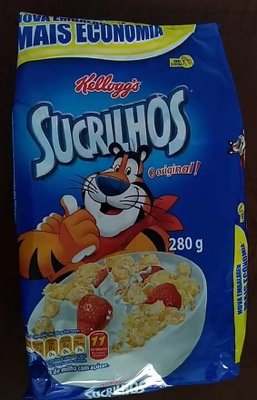
In Brazil, Kellogg’s Sucrilhos follow the same logic: the list recorded on Open Food Facts reads milho, açúcar, malte (maize, sugar, malt). The malt is there, and with it the “contém glúten” statement that is compulsory in Brazil.
Malt is not limited to maize. It also turns up in puffed rice cereals and chocolate cereals. That is why you cannot choose a cereal by its name: “corn”, “rice” or “maize” tell you the main grain, not what has been added.
“Corn” and “rice” cereals: read the label
Even without malt, a maize cereal is not gluten free by default. It is often made in a factory that also handles wheat, barley or oats.
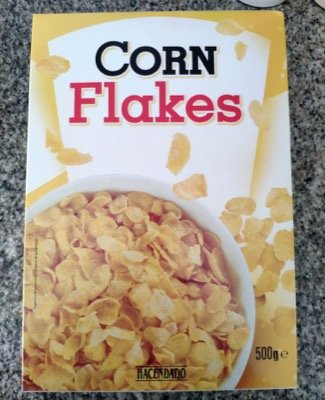
A concrete example, checked in September 2026 on the website of the Spanish supermarket Mercadona: its Hacendado Corn Flakes with 0% added sugar are made of 98% maize, salt and an antioxidant. No malt. But the label says: “may contain traces of cereals containing gluten”. Without a gluten-free claim, coeliacs avoid it, however clean the recipe looks.
The AIC, Italy’s coeliac association, is clear on this: breakfast cereals made from permitted grains — puffed, flaked or in muesli — are classed as “at risk”. They are fine if they say senza glutine. Those made with wheat, barley, rye or non-certified oats are prohibited.
For a coeliac
What works
- "Gluten free" or the crossed grain symbol on the box
- Maize, rice, buckwheat, millet… and nothing else in the list
- Oats labelled gluten free, if you tolerate them
Leave on the shelf
What doesn't
- Malt, malt extract, malt flavouring or barley malt syrup
- "May contain traces of gluten"
- Non-certified oats, wheat, rye or barley flakes
The word maltodextrin, on the other hand, is not a warning sign: it is a sugar, exempt from allergen labelling even when made from wheat. We explain why in a dedicated article. And the difference between an ingredients list and a traces warning is the subject of our article on “may contain traces”.
Muesli, granola and porridge
Muesli, granola and porridge nearly all share the same base: oats. Oats do not contain gluten in the strict sense, but they are almost always contaminated with wheat or barley in the field, the silo and the mill. Many mueslis also contain wheat, rye or barley flakes, and biscuit pieces.
The AIC only considers oats permitted if the product says senza glutine. And even certified, oats are not tolerated by every person with coeliac disease. We have a whole article on oats — it is, incidentally, the case that led to Nutrixe being created.
For porridge lovers there are oat-free alternatives: buckwheat, millet, rice or quinoa flakes. With the same proviso — a gluten-free claim on the pack.
Gluten-free versions from big brands
The big brands have responded, but not in the same way everywhere. Here is what we could check on their official sources in September 2026:
| Brand | Product | What we know |
|---|---|---|
| Nestlé | Gluten-free Corn Flakes (Go Free range) | Launched in 2014 in Spain and Austria, announced for France, Germany and Switzerland in 2015 (group press release); the Nestlé Cereals website presents the gluten-free range |
| Kellogg’s | Corn Flakes Gluten Free | Sold in Australia, according to the brand’s Australian website; the classic version sold in France contains barley malt |
| Schär | Corn Flakes | Specialist brand: maize, sugar, salt, sunflower lecithin, vitamins; labelled gluten free |
| Conad (Italy) | Alimentum Corn Flakes senza glutine | Supermarket own brand, “specifically formulated for people intolerant to gluten” |
Sources: official brand and retailer websites, checked in September 2026. Ranges change and differ from country to country: trust the wording on the box, not the brand logo.
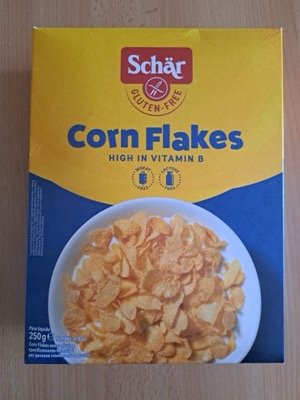
Two lessons from this table. First: the same brand sells two different products, one with malt and one gluten free, sometimes in the same aisle. Second: a gluten-free version that exists in one country does not necessarily exist in yours. In the UK, as anywhere else, the classic box and the gluten-free box have to be told apart by the label, not by the name.
Supermarket own brands
Almost every supermarket has its own cornflakes. Some are formulated gluten free, like Conad’s Alimentum range in Italy. Others are made of almost pure maize but carry a traces warning, like the Mercadona example above. And others follow the classic malt recipe.
So there is no rule per retailer. This is exactly where the Nutrixe scanner saves time: it reads the ingredients list and the traces warnings, spots “barley malt”, “cevada” or “Gerste”, and tells apart a product that contains gluten (red) from one that may contain traces (orange). Oats without a gluten-free label also come out orange.
Photos and ingredient lists: Open Food Facts, a collaborative open-licence database, retrieved on 26 September 2026. Recipes change: the label on the packet in your hand is what counts.
Breakfast at the hotel
A hotel buffet piles up the risks: shared cereal dispensers, spoons moving from one tray to another, a communal toaster, muesli next to the cornflakes. Even when the hotel offers a gluten-free box, it is sometimes served with the same scoop. We are preparing a full article on gluten-free hotels.
The simplest answer is often to have breakfast elsewhere, somewhere entirely gluten free. A few examples from the database:
- Rice Me Deli, Lisbon — a 100% gluten-free pastry shop and café, certified by the Portuguese coeliac association, with a breakfast buffet.
- Cortese Cafè, Florence — between Palazzo Pitti and the Ponte Vecchio, vegan and entirely gluten-free pastries, described by coeliac reviewers as the best gluten-free breakfast in town.
- Isabella Glutenfreie Pâtisserie, Aachen — on the Münsterplatz, a 100% gluten-free breakfast, classic, vegetarian or vegan.
- Café Mareva Montmartre, Paris — 100% gluten-free, almost lactose-free brunch.
- Bloome by Sasha, Barcelona — 100% gluten-free brunch in the Gothic Quarter; 4.8 from nearly 5,000 reviews.
In short
- Classic cornflakes often contain barley malt: they are not gluten free.
- Even 98% maize, a cereal can carry a gluten traces warning.
- Muesli, granola and porridge are oat-based: only if labelled gluten free.
- Nestlé, Kellogg’s (in Australia), Schär and some own brands sell gluten-free cornflakes — next to classic versions that are not.
- At the hotel, the shared buffet is the real risk.
Two boxes, one gesture. Scan the barcode: the Nutrixe scanner spots barley malt and traces warnings, in the language of the label. Discover the app.


