Nutrixe
Yeast is a microscopic fungus. It has no gluten, no more than a button mushroom does. And yet “brewer’s yeast” and “yeast extract” keep coming up in the questions of people with celiac disease, rightly, because what counts is not the yeast, but what it grew on.
Three yeasts, three situations
Baker’s yeast (Saccharomyces cerevisiae), fresh in a block or dried in a sachet, is grown industrially on sugar media, usually beet or cane molasses. No cereal: gluten-free. That is the simple case.
Brewer’s yeast, the same species or a cousin, owes its name to its origin: it is traditionally recovered at the end of beer fermentation, so after living in a malted barley wort. Dried and sold as flakes, tablets or capsules as a supplement (B vitamins, skin, hair), it may retain gluten residues from the barley. Some manufacturers grow it on a cereal-free medium or purify it, and say so with a “gluten-free” claim. The others say nothing, and doubt is well founded.
Baking powder is not a yeast at all: a mix of bicarbonate and an acid, on a starch carrier. That carrier is sometimes wheat starch, generally declared; corn-starch baking powders labelled gluten-free exist.
Yeast extract: the divisive case
Yeast extract is obtained by bursting yeast cells and recovering their contents, rich in amino acids and “umami” taste. It is found in stocks, crisps, soups, sauces, ready meals, and in British and Australian savoury spreads.
The point: this extract can be made from brewery yeast, hence from barley. The gluten residue then depends on the process. The textbook case is British Marmite, whose label explicitly declares barley, wheat, oats and rye: it is not gluten-free. The brand sells a separate “gluten free” version. Australian Vegemite, by contrast, is now made gluten-free and certified as such: the two look alike and are not equivalent.
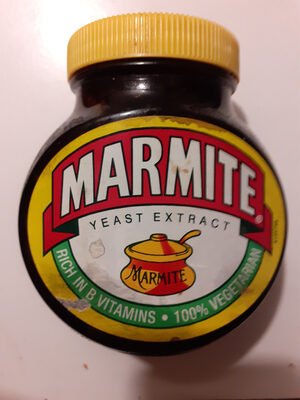
Photo and ingredient list: Open Food Facts, a collaborative open-licence database, retrieved on 5 September 2026. Recipes change: the label on the product in your hand is what counts.
For a yeast extract in a European stock or crisps, the allergen rule applies: if barley residues are present significantly, barley must be declared. A yeast extract with no barley mention in a product labelled “gluten-free” poses no problem. In a product with no claim, it joins the “probably safe, not guaranteed” category we describe for traces.
Where the risk is real
- Brewer’s yeast supplements without a “gluten-free” claim: the most frequent case, because nobody thinks to read a capsule’s label. Most serious brands state the origin; without it, pick another.
- Yeast extract spreads, Marmite first.
- “Gluten-removed” beers are not this article’s subject but follow the same logic, barley is there, the gluten has been treated, and we cover them elsewhere.
Where it is not
- Baker’s yeast, fresh or dried.
- Nutritional yeast flakes sold “gluten-free” (often grown on molasses).
- Yeast extract in a product bearing the “gluten-free” claim.
- Gluten-free bread risen with yeast: the yeast brings nothing.
In short
- Yeast has no gluten; its growth medium may.
- Baker’s yeast: gluten-free. Brewer’s yeast: gluten-free only if the manufacturer says so.
- Yeast extract: safe in a “gluten-free” product, to be checked elsewhere; Marmite is not gluten-free.
- Baking powder: check the carrier (wheat or corn starch).
Scan the box. The Nutrixe scanner reads a supplement's ingredient list like a food's, and flags barley when it is declared. Discover the app.